Addition‑cured (platinum‑cure) RTV‑2 silicone elastomers underpin demanding applications—from electronics potting and mold making to industrial tooling—thanks to their thermal stability, precision curing, and long‑term reliability. The right selection of raw materials is essential to deliver consistent processing and end‑use performance. BRB supports formulators with a comprehensive portfolio of silicone building blocks and additives designed for robust, scalable formulations.
1. Base Polymers: Vinyl‑Terminated PDMS
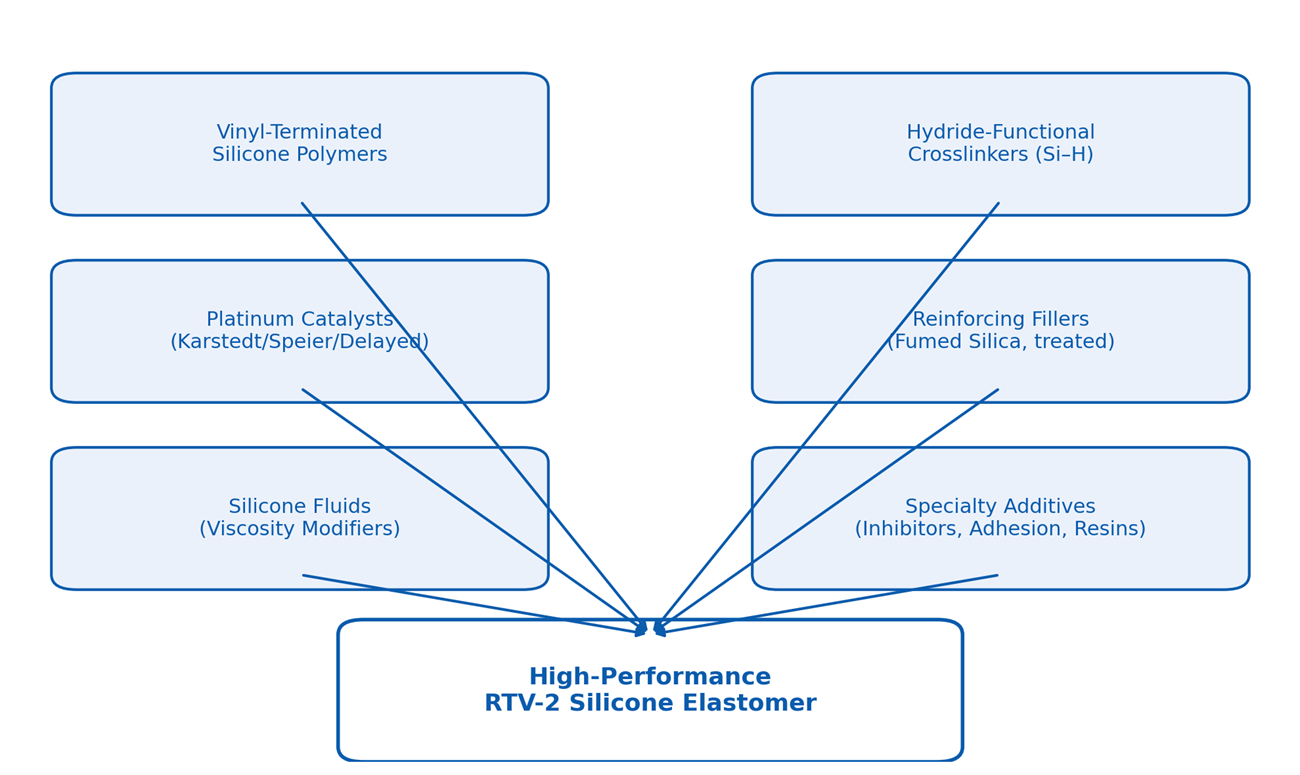
Vinyl‑terminated silicone polymers define viscosity, mechanical properties, and cure behavior. Select grades with appropriate vinyl functionality and viscosity to match target hardness, tear, and elongation. BRB supplies vinyl‑functional PDMS suitable for low‑ to high‑modulus systems and compatible with hydride crosslinkers.
2. Hydride‑Functional Crosslinkers & Modifiers (Si–H)
Crosslink density—and thus hardness and elasticity—is governed by the vinyl:hydride ratio. Linear and resin‑modified hydride crosslinkers enable tuning from soft, flexible gels to high‑strength elastomers. BRB hydride materials offer controlled Si–H content to support predictable cure kinetics.
3. Platinum Catalyst
RTV‑2 addition curing relies on platinum catalysis (e.g., Karstedt)). BRB raw materials are engineered for compatibility with commonly used Pt catalysts and process conditions.
4. Reinforcing Fillers
High‑surface‑area fumed silica—often surface‑treated—delivers mechanical reinforcement. Pre‑dispersed silica in vinyl PDMS can reduce mixing time and improve stability. BRB can support with dispersions and processing guidance to reach target rheology and mechanicals.
5. Silicone Fluids
Low‑viscosity silicone fluids help tune flow, degassing behavior, softness, and processing latitude without compromising compatibility. Select fluids to balance pot life and cure profile.
6. Specialty Additives
Additives enable application‑specific performance: inhibitors for pot‑life control, adhesion promoters for substrate bonding, silicone resins for hardness and thermal resistance, and silicone polyethers for improved wetting.